Journal → Artists
Artists and practicesConcrete Poetry in Manchester's Contemporary Art
Editorial team · 3 min read
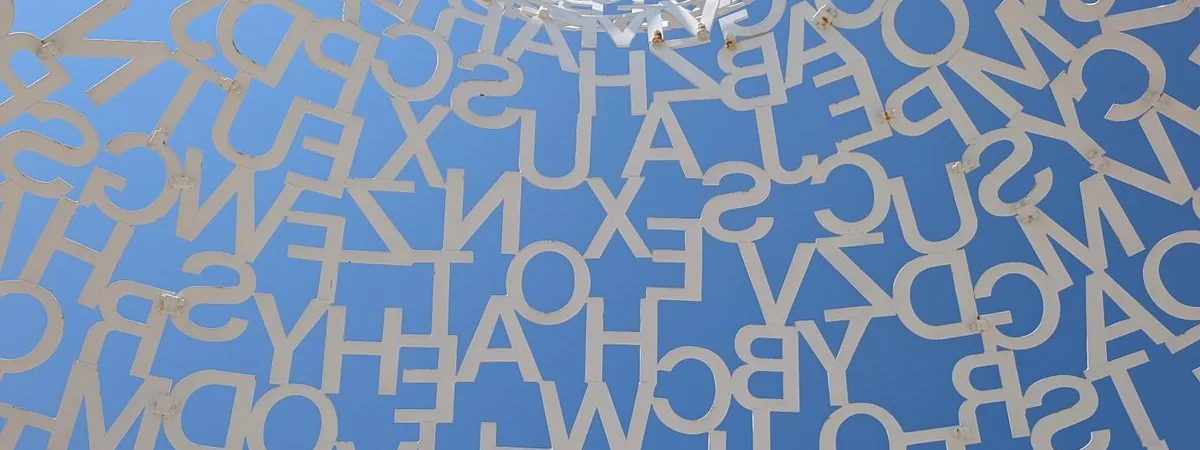
Explore concrete poetry as a direction in Manchester's contemporary art. Read about its practitioners and influence on the scene.
Concrete Poetry: Definition and Origins
Concrete poetry is a direction in which the visual arrangement of words, letters and sometimes other signs is part of the poem's meaning. The poem is treated as an object on the page, not only as a sequence of sentences. Its tradition developed in the middle of the twentieth century, when several poets in different countries began to work with space, sound and typography as materials in their own right.
The origins of the form are usually traced to parallel experiments in more than one country, rather than to a single founder. Shared interests included the rhythm of language, the reduction of a poem to its essential units and the relation between writing and visual design. These experiments connected poetry with painting, design and music, and they remain a reference point for artists who work across forms.
Key Figures in Concrete Poetry
Among the poets most often associated with concrete poetry are Eugen Gomringer, who is widely cited as a founder of the direction, and Ian Hamilton Finlay, whose work brought visual poetry into gardens, public sites and printed editions. Augusto de Campos in Brazil is another figure frequently discussed in histories of the form. Each developed a distinct approach, and their work is better understood in its own terms than as a single style.
This section is a general guide to the field. It does not claim that any of these poets had a direct link to Manchester, and it does not describe local practitioners as part of a settled group. Readers who want to study the tradition in depth should consult the primary works and reputable histories of the movement.
Concrete Poetry in Manchester's Art Scene
Concrete poetry has a presence in many cities as a practice that sits between poetry, visual art and design. In Manchester, as elsewhere, it may appear in printed works, exhibitions, public text and collaborations between writers and artists. Such work tends to be made by people who move between fields and who are interested in how language looks as well as what it says.
Because the form crosses boundaries, it can be easy to overlook in a city's art listings. A useful way to find it is to look for exhibitions and publications that treat text as a visual material. The journal's approach is to describe such work where the editorial team has seen it, rather than to claim a settled local tradition.
How Concrete Poetry Influences Contemporary Art
The influence of concrete poetry on contemporary art is visible in works that use text as image, in artists who arrange language on walls or in space, and in designers who treat typography as a structural element. Its interest in the material of language has also shaped digital art and experimental publishing, where the look of a text is part of its effect.
Influence of this kind is often indirect. An artist may not describe their work as concrete poetry, but may draw on its methods of reduction, repetition and spatial arrangement. Reviews and columns can point out such connections when they are present in the work, without assuming that every use of text in art has the same origin.
Examples of Concrete Poetry in Practice
Concrete poems take many forms. Some arrange a single word across a page in patterns that change how it is read. Others repeat letters or syllables to create rhythm, use the shape of the page as a frame for meaning or combine text with drawn or printed marks. Some are meant to be read aloud, others to be looked at for a long time, and some ask the reader to move around them.
Understanding such work requires slowing down. The reader needs to notice the arrangement, the spacing and the way the eye moves. A useful exercise is to ask what would be lost if the poem were typed out in ordinary lines, because that loss often shows what the visual form adds to the meaning.
Frequently asked questions
What is concrete poetry?
Concrete poetry is a direction in which the visual arrangement of language is part of the poem's meaning. The poem is treated as an object on the page, and its form is considered alongside its words.
Who are notable concrete poets?
Eugen Gomringer and Ian Hamilton Finlay are among the poets most often discussed in histories of the form, and Augusto de Campos is another frequently cited figure. Their work is best approached through their own publications and through reputable histories of the movement.
Editorial view
Concrete poetry asks readers to slow down and look at language as an object. The editorial team's view is that this direction still matters because it challenges a habit of reading as passing through words to reach a meaning. When the arrangement of letters becomes part of the poem, the page becomes a place to stay rather than a route to leave.
The team is cautious about claims that a single form explains a whole scene. Concrete poetry is one direction among many, and its influence on painting, design and digital work is real but partial. A useful review of such work describes how the text is arranged, what the arrangement adds and where the poem's meaning begins to slip away.